Skip to header Skip to main navigation Skip to main content Skip to footer
Home
Butte Montana
The Richest Hill on Earth

Main navigation

  • Home
  • Articles
  • Business Directory
  • Dining
  • History
  • Lodging
  • Outdoors
  • Shopping
  • Things to Do
  • Weather
  • Webcams

Articles

The Great Fire of 1895: The Night Butte's Warehouses Exploded
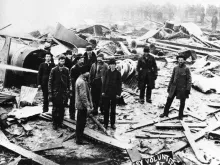
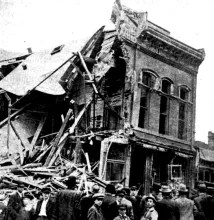
Volunteers standing amid the wreckage of the Kenyon-Connell and Butte Hardware warehouses after the January 15, 1895 explosion in Butte, Montana.

Did you know that one of the deadliest nights in Butte history began with a routine fire alarm in the warehouse district? Shortly before 10 p.m. on January 15, 1895, Butte Police Officer James Steinborn was walking his beat when he spotted flames coming from the Kenyon-Connell Commercial Company warehouse. He rushed to fire call box 72, on the corner of Utah and Iron Streets, and alerted the fire department. Kenyon-Connell supplied tools and materials to the mines, and its warehouse stood among railroad tracks, sheds, and other mercantile warehouses just east of Arizona Street.
  • Read more about The Great Fire of 1895: The Night Butte's Warehouses Exploded

The Columbia Gardens: Butte's Beloved Amusement Park, 1899–1973

For seventy-four years, the people of Butte had a pleasure ground of their own at the foot of the East Ridge, a short streetcar ride east of the city. The Columbia Gardens opened to the public on June 4, 1899, and it closed for the last time on Labor Day, September 3, 1973. During those years it was the only major amusement park in Montana, and admission was always free. Generations of Butte children measured their summers by its flower beds, its dance pavilion, and its rides.

  • Read more about The Columbia Gardens: Butte's Beloved Amusement Park, 1899–1973

Our Lady of the Rockies: The 90-Foot Statue Above Butte

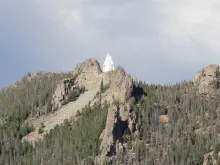
Our Lady of the Rockies, the 90-foot statue on the ridge above Butte, Montana.

High on the East Ridge of the Continental Divide above Butte stands a white figure that travelers can see for miles. Our Lady of the Rockies is a ninety-foot statue built in the likeness of Mary, the mother of Jesus, and she looks down on the city from a base that sits 8,510 feet above sea level and roughly 3,000 feet above the streets of Butte. The statue is illuminated at night, and motorists on Interstate 90 and residents throughout the valley have made her a familiar and comforting presence.

  • Read more about Our Lady of the Rockies: The 90-Foot Statue Above Butte

Evel Knievel of Butte: The Daredevil Who Carried His Hometown to Fame

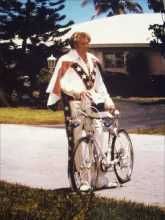
Evel Knievel in his stars-and-stripes leathers at his home in Fort Lauderdale, Florida, in the 1970s.

Robert Craig Knievel was born on October 17, 1938, in Butte, Montana, the first of two children of Robert E. Knievel and Ann Marie Keough Knievel. His parents divorced when he was young, and both parents left Butte, so Robert and his younger brother, Nicolas, were raised in the city by their paternal grandparents, Ignatius and Emma Knievel. The Butte of his childhood was a hard-working copper mining city, famous as the Richest Hill on Earth, and it prized toughness, nerve, and showmanship.

  • Read more about Evel Knievel of Butte: The Daredevil Who Carried His Hometown to Fame

Butte's Chinese Community, Its Historic Chinatown, and the Mai Wah Museum

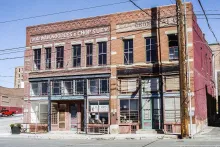
The Mai Wah Building in Butte, Montana, with its painted sign.

Chinese immigrants were part of Montana from its earliest mining days. Chinese people began coming to Butte in 1868, with its first placer gold mines, and the census of 1870 counted almost 2,000 Chinese residents in Montana, ten percent of the territory's population. Many had come from Guangdong province in southern China, driven by famine and unrest, to dig for gold and help build railroads. In Butte, Chinese miners were gradually forced out of mining and settled at the edge of the growing city, where they built a community of their own.

  • Read more about Butte's Chinese Community, Its Historic Chinatown, and the Mai Wah Museum

Uptown Butte and the Butte-Anaconda Historic District: A Landmark City on the Hill

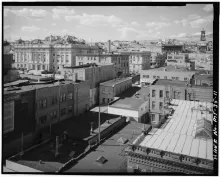
Historic photograph of Uptown Butte with the Silver Bow County Courthouse at left.

Butte does not have a downtown in the usual sense. It has Uptown, a dense city center of brick and stone that climbs the steep flank of the Butte Hill, with mine headframes standing on the slopes above the rooftops. The name reflects the geography, because nearly everything in the historic core is uphill from the flats to the south.

  • Read more about Uptown Butte and the Butte-Anaconda Historic District: A Landmark City on the Hill

The Gibraltar of Unionism: Butte's Labor Movement, the Dynamited Hall, and Frank Little

The wreckage of the Butte Miners' Union Hall after it was dynamited in 1914.

Few American cities were as thoroughly unionized as Butte. Miners organized on June 13, 1878, when workers at the Alice and Lexington silver mines faced a wage cut from $3.50 to $3.00 a day and formed the Butte Workingmen's Union to resist it. The organization, soon known as the Butte Miners' Union, held the $3.50 wage, grew into one of the largest local unions in the United States, and made June 13, Miners' Union Day, a city holiday. Nearly every trade in town eventually organized, and Butte earned a name that followed it for decades: the Gibraltar of Unionism.

  • Read more about The Gibraltar of Unionism: Butte's Labor Movement, the Dynamited Hall, and Frank Little

The War of the Copper Kings

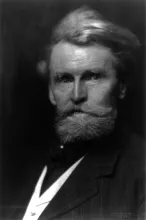
Portrait of copper king William A. Clark.

In the late nineteenth century, the Butte hill held some of the richest copper deposits on earth, and copper was becoming essential to a nation wiring itself for electricity. Three men fought for control of that hill. Their struggle, waged from the late 1880s until 1906 with money, newspapers, lawyers, and political campaigns, is remembered as the War of the Copper Kings.

  • Read more about The War of the Copper Kings

The Berkeley Pit: From Open-Pit Mine to a Lake That Must Be Watched Forever

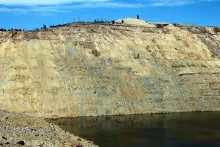
The Berkeley Pit in Butte, Montana, its terraced walls surrounding the rising lake.

For nearly seventy years, Butte made its living underground. Thousands of miners followed rich veins of copper deep below the hill in a warren of shafts and tunnels. In 1955, the Anaconda Company changed the direction of mining in Butte. Instead of going deeper, the company began to dig from the surface down, opening an enormous open-pit mine on the east side of the city. The pit took its name from the older underground Berkeley mine near the spot where the digging began.

  • Read more about The Berkeley Pit: From Open-Pit Mine to a Lake That Must Be Watched Forever

The Granite Mountain–Speculator Disaster of 1917

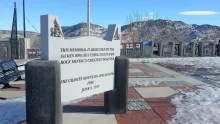
The memorial stone at the Granite Mountain–Speculator mine disaster site near Butte.

On the night of June 8, 1917, Butte was a city working at full speed for a nation at war. The United States had entered the First World War that spring, and copper was urgently needed for shell casings, wire, and munitions. The mines on the Butte hill were running around the clock, and about 410 men were underground on the night shift in the Granite Mountain and Speculator mines, two connected workings operated by the North Butte Mining Company on the northern edge of the city.

  • Read more about The Granite Mountain–Speculator Disaster of 1917

Pagination

  • First page « First
  • Previous page ‹‹
  • Page 1
  • Current page 2
  • Page 3
  • Next page ››
  • Last page Last »

Butte, MT Weather

Loading current conditions...

Loading forecast...

Upcoming Events

Butte Events Calendar

This week in Butte:

  • Thu, Nov 26: The second annual Montana Tech Turkey Trot, a 5K and one-mile walk or run benefiting the Butte Food Bank, starts at 9:30 a.m. at the Three Bears parking lot on Blacktail Loop, with registration at 8:30 a.m.
  • Fri, Nov 27: Roadless, a documentary film premiere, screens at 6:30 p.m. at the Covellite Theatre.
  • Sat, Nov 28: Small Business Saturday is celebrated in Uptown Butte.
  • Sat, Nov 28: Witches & Wishbones, a two-mile Witch Walk & Waddle with witchy attire encouraged, starts at 11:00 a.m. at the Anselmo Mine Yard.
  • Sat, Nov 28: The World Ballet Company performs The Nutcracker at 7:00 p.m. at the Mother Lode Theatre.
  • Sat, Nov 28: Illin Degenerates performs at 9:00 p.m. at the Covellite Theatre.
  • Sun, Nov 29: Resonant Glass, a free evening of strings, spoken word, and live collaboration benefiting the Covellite Stained Glass Restoration Project, opens with doors at 5:00 p.m. at the Covellite Theatre.

Copyright © 2026 Rocky Mountain Madman LLC - All rights reserved

Developed and Designed by Rocky Mountain Madman LLC