
Chinese immigrants were part of Montana from its earliest mining days. Chinese people began coming to Butte in 1868, with its first placer gold mines, and the census of 1870 counted almost 2,000 Chinese residents in Montana, ten percent of the territory's population. Many had come from Guangdong province in southern China, driven by famine and unrest, to dig for gold and help build railroads. In Butte, Chinese miners were gradually forced out of mining and settled at the edge of the growing city, where they built a community of their own.
That community became one of the most substantial Chinatowns in the inland West. In the early 1880s, a Chinese immigrant named Ing Pong built a log cabin just west of Main Street, and Chinatown grew around it, bounded by West Galena, South Main, West Mercury, and South Colorado Streets. More than 2,000 people lived in Butte's Chinatown by 1910, and estimates place its peak at about 2,500, making it the largest Chinatown between Minneapolis and Seattle. Butte's 1914 city directory listed sixty-two Chinese businesses, including laundries, restaurants, herb shops, and four physicians practicing herbal medicine.
The Chinese Exclusion Act of 1882, the first federal restriction on immigration to the United States, barred new Chinese laborers from entering the country and denied Chinese immigrants naturalized citizenship. In Butte, an unwritten understanding between organized labor and the mining companies kept Chinese workers out of the mines, the smelters, and the unions. Labor unions led boycotts against Chinese businesses in the early 1890s, and in 1896 the unions joined with the Butte Chamber of Commerce in a boycott of Chinese and Japanese businesses and of any business employing Chinese or Japanese workers.
Butte's Chinese leaders answered in court. Hum Fay, a restaurant owner, joined with Dr. Huie Pock, the merchant Quon Loy, and many others to sue the boycott's organizers in federal court, represented by Montana attorney Wilbur Fisk Sanders. In Hum Fay, et al. v. Baldwin, the court ruled in favor of the Chinese plaintiffs, ordered the boycott ended, and directed the defendants to pay $1,750 toward the plaintiffs' legal costs. The victory ended organized boycotts in Butte, although it could not restore an estimated $500,000 in lost business, and hundreds of residents left the city during those years.
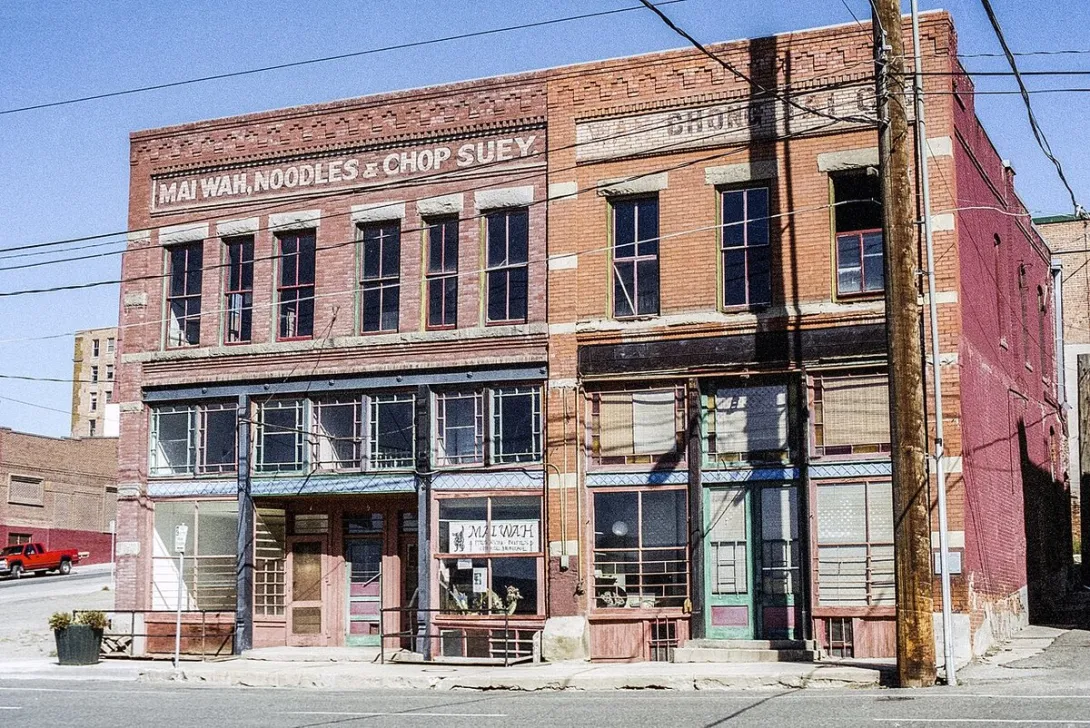
Two buildings on West Mercury Street carried Chinatown into the present. The Wah Chong Tai Company, a mercantile firm founded in Seattle, opened a Butte branch on West Galena Street in the early 1890s. Chin Hin Doon had become a merchant with the company by 1894, and by 1899 the firm was operating from a new brick building at West Mercury Street and China Alley. The mercantile sold imported food, tea, porcelain, and silk, and served as a community center offering lodging, translators, jobs, and news from home. In 1909 the company built a second brick building beside it, with street-level storefronts, a hidden half-story of small rooms known as a "cheater story," and the Mai Wah Noodle Parlor upstairs. Mai Wah means "beautiful and luxurious" in Chinese. His son Albert Chinn ran the businesses in the 1930s, and the mercantile remained open into the 1940s. It is regarded as the country's only remaining original Chinese store of its era.
By then, Chinatown itself was fading. Exclusion, economic change, and demolitions that cleared old buildings for parking lots shrank the neighborhood, and by 1940 only seventy to eighty Chinese residents remained in Butte. The Pekin Noodle Parlor, on South Main Street since 1911, is considered one of the oldest continuously operating Chinese restaurants in the United States. In 1991 the Mai Wah Society was founded to preserve and interpret Butte's Asian heritage, and its Mai Wah Museum fills the Wah Chong Tai and Mai Wah Noodle Parlor buildings at 17 West Mercury Street with some 2,500 artifacts, from shop counters and ledgers to cookware and photographs. A Partners in Preservation grant of $133,000 in 2018 funded restoration of the buildings' exteriors, and in 1994 the society revived Butte's Chinese New Year parade, a Chinatown tradition from the nineteenth century. Together, the museum and the parade ensure that the Chinese families who helped build Butte are remembered as part of its history.
Photo: the Mai Wah Building in Butte, Montana. Photograph by Acroterion, CC BY-SA 4.0, via Wikimedia Commons.