On the night of June 8, 1917, Butte was a city working at full speed for a nation at war. The United States had entered the First World War that spring, and copper was urgently needed for shell casings, wire, and munitions. The mines on the Butte hill were running around the clock, and about 410 men were underground on the night shift in the Granite Mountain and Speculator mines, two connected workings operated by the North Butte Mining Company on the northern edge of the city.
The fire began with an accident during work that was meant to make the mine safer. The company was installing an electric cable in the Granite Mountain shaft as part of a new fire protection and sprinkler system. Earlier that day the heavy cable, which was wrapped in oil-soaked cloth insulation, had slipped from the hands of the workmen lowering it and had fallen in a tangled coil below the 2,400-foot level, where its covering was damaged. Late that evening, a small party went down to inspect the cable. As assistant foreman Ernest Sullau examined the damage, the flame of his carbide lamp touched the frayed, oily insulation, and the cable caught fire.
The Granite Mountain shaft acted like a chimney. Flames, smoke, and poisonous gas, including carbon monoxide, raced upward and then spread through the maze of tunnels that connected the Granite Mountain workings with the Speculator mine and neighboring properties. The signaling system in the shaft burned out, which made it harder to warn the men below and to organize the hoisting of survivors. Many miners escaped through adjoining mines, and rescue crews from across the district hurried to the scene, but for the men working in the deepest levels the gas arrived faster than any warning could.
Most of the men who died were not burned. They suffocated as the fire consumed the oxygen in the workings and filled the tunnels with gas. Some were found behind concrete bulkheads, the safety walls built across worked-out passages, which had no doors and offered no way through. Other men saved themselves by building bulkheads of their own. They sealed themselves into dead-end tunnels with timbers, canvas, and even their own clothing, and they waited in darkness and thinning air for rescue crews to reach them.
Two of those improvised refuges became central to the story Butte still tells. On the 2,400-foot level, a young nipper named Manus Duggan, whose job was to carry tools and supplies to the miners, gathered twenty-nine men behind a bulkhead and kept them calm and organized for more than a day and a half. When Duggan finally judged that the group should try for the shaft, he led them out and then became separated from them, overcome after his long exposure to bad air. Twenty-five of the men who had sheltered with him survived. On the 2,200-foot level, shift boss James D. Moore led a smaller group behind a bulkhead, where they remained for about fifty hours. Moore wrote farewell letters to his wife in his time book while they waited, and he died shortly before rescuers reached his party, although several of his men were revived and brought to the surface alive.
When the rescue and recovery work ended, 168 miners had lost their lives. It remains the deadliest hard-rock mining disaster in the history of the United States. Grief in Butte was quickly joined by anger. Within days, miners formed the Metal Mine Workers Union and went on strike over safety and working conditions, and the disaster became a turning point in the city's long and difficult labor history. The strike continued into December of 1917 before it was called off.
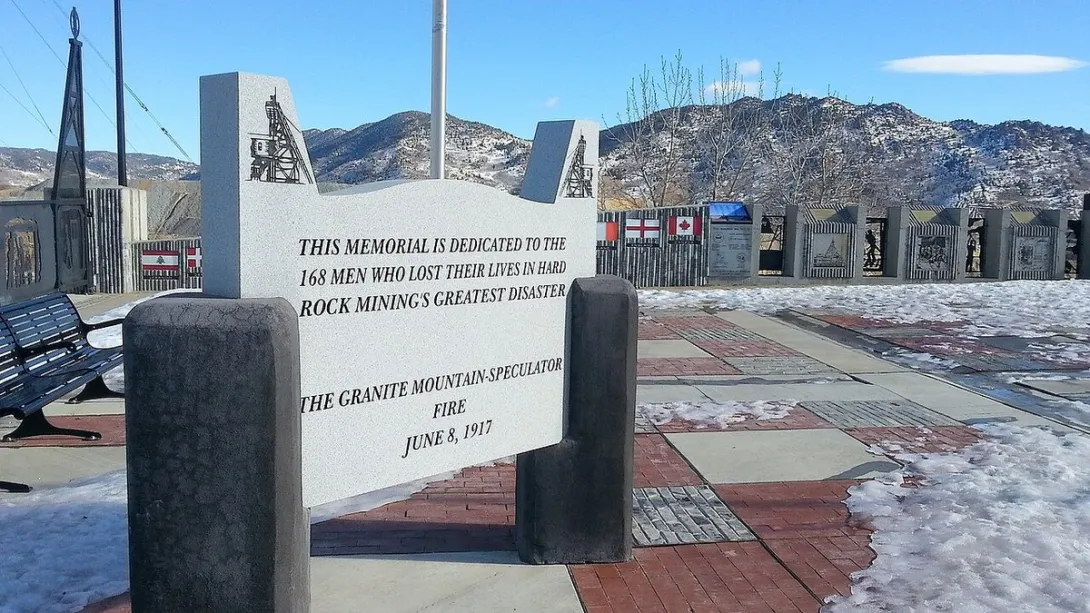
Butte has never forgotten that night. The Granite Mountain Memorial overlook above the old mine site honors the 168 men by name, displays the flags of the many nations from which Butte's immigrant miners had come, and preserves the words that trapped men wrote underground. Visitors who stand there today look out over the hill that made Butte famous, and over a community that still measures the wealth of that hill against the lives it cost.
Photo: the memorial plaque to the victims of the Granite Mountain-Speculator disaster. Photograph by Banjodog, CC BY-SA 3.0, via Wikimedia Commons.