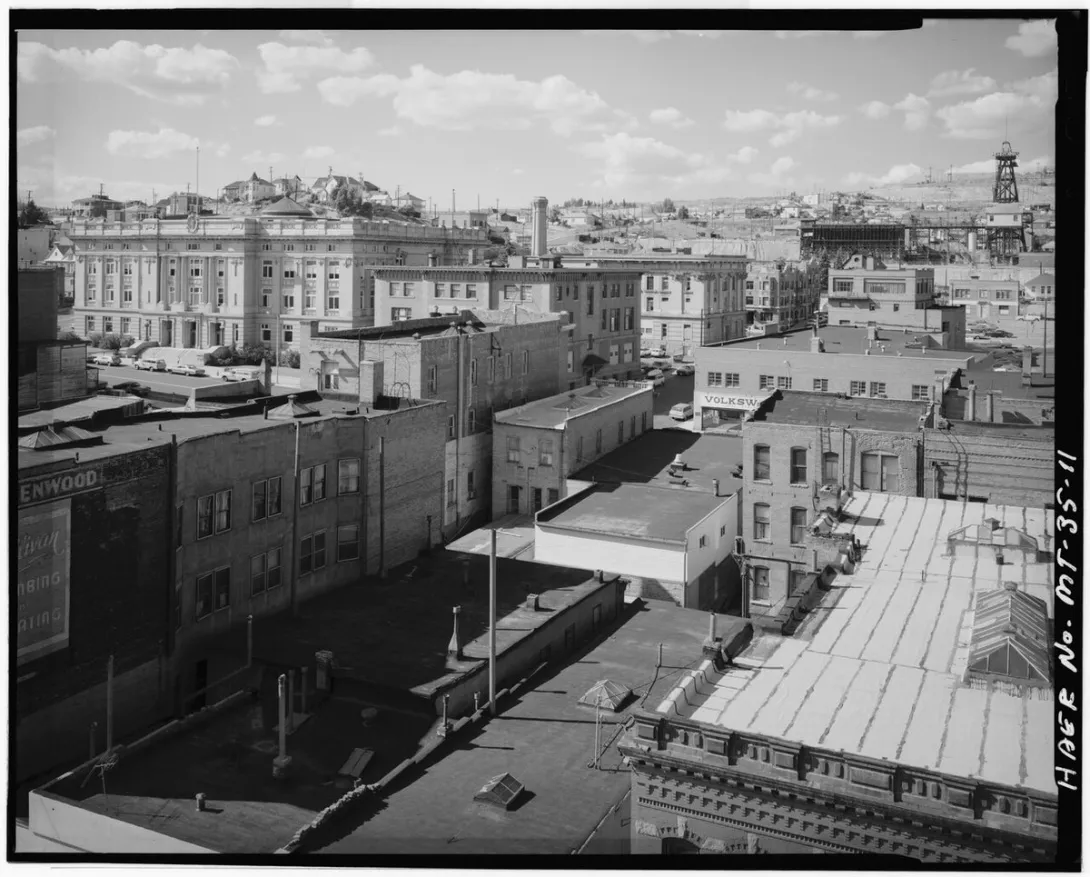
Butte does not have a downtown in the usual sense. It has Uptown, a dense city center of brick and stone that climbs the steep flank of the Butte Hill, with mine headframes standing on the slopes above the rooftops. The name reflects the geography, because nearly everything in the historic core is uphill from the flats to the south. Visitors who walk its streets today are walking through the heart of the Butte-Anaconda Historic District, one of the largest National Historic Landmark districts in the United States and, by the National Park Service's count, the one with the greatest number of historic resources in the nation.
Copper built this cityscape. Butte began as a gold camp in the 1860s and grew through a silver boom in the 1870s, but its great era began in 1881, when Marcus Daly bought the Anaconda mine and began assembling the enterprise that became the Anaconda Copper Mining Company. Demand for copper soared with electrical wiring and, during the First World War, ammunition. In the early 1900s, the Butte-Anaconda region produced nearly one third of the entire world's copper, and Butte earned its famous nickname, the Richest Hill on Earth. At its peak the city was one of the largest and most cosmopolitan in the Rocky Mountain West, filled with immigrants from Ireland, Cornwall, Finland, Italy, China, and many other places.
The wealth of that era still stands on Uptown's streets, in part because a major fire in 1879 led the city to require new construction in brick and stone. The Copper King Mansion, built from 1884 to 1888 on West Granite Street for William Andrews Clark, one of Montana's celebrated Copper Kings, is a thirty-four-room Romanesque Revival Victorian residence with frescoed ceilings, stained glass, and parquet floors of imported wood. It was added to the National Register of Historic Places in 1970 and now operates as a bed and breakfast and museum. A few blocks away, the nine-story Hotel Finlen opened on January 1, 1924, at East Broadway. Designed by the firm of Shanley and Baker and modeled after New York City's Hotel Astor, its French Second Empire tower remains the signature of the Uptown skyline. Around them stand the Silver Bow County Courthouse, completed in 1912, Cass Gilbert's Metals Bank Building of 1906, the Hennessy Building, theaters, churches, union halls, and rows of miners' cottages and boarding houses that housed the workforce.
The federal government recognized Butte's national significance early. Butte was designated a National Historic Landmark on July 4, 1961, for its central role in American copper production. In 2006, the landmark was greatly expanded and renamed the Butte-Anaconda Historic District. The expanded district covers 9,774 acres and reaches beyond Uptown to include the mining landscape and headframes above the city, the neighboring town of Walkerville, the smelter city of Anaconda to the west, the great Anaconda smelter stack, and the route of the Butte, Anaconda and Pacific Railroad that linked them. Within the district are 7,910 recorded historic resources, of which 6,015 contribute to its significance, including 5,975 buildings, thirty-seven structures, two sites, and one object. The district's period of significance runs from 1876 to 1934, and its story joins two themes that the National Park Service treats as inseparable here: the industrialization of the American West and the rise of the labor movement that answered it.
Uptown survived because Butte's bust, unlike the abandonment that emptied so many mining camps, was gradual. Copper mining declined through the twentieth century, the Anaconda Company was sold to the Atlantic Richfield Company in 1977, and large-scale mining in Butte ended in the early 1980s. Many grand buildings stood underused rather than demolished, and the consolidated city and county of Butte-Silver Bow, home to 34,494 people at the 2020 census, has made preservation a civic calling. Today visitors can take walking and trolley tours past the headframes, tour the World Museum of Mining at the Orphan Girl Mine, and stand at the viewing platform above the Berkeley Pit. What rewards them most, however, is Uptown itself: a working Montana city whose streets still read, block by block, as the built record of the richest hill on earth.