For nearly seventy years, Butte made its living underground. Thousands of miners followed rich veins of copper deep below the hill in a warren of shafts and tunnels. In 1955, the Anaconda Company changed the direction of mining in Butte. Instead of going deeper, the company began to dig from the surface down, opening an enormous open-pit mine on the east side of the city. The pit took its name from the older underground Berkeley mine near the spot where the digging began.
Open-pit mining suited the ore that remained. Much of the rock near the surface carried less than one percent copper, which was too low in grade to mine profitably by underground methods. With power shovels and haul trucks, however, a company could move that rock in bulk and still make money. Within its first year, the Berkeley Pit was producing about 17,000 tons of ore a day. The trucks grew larger as the pit grew deeper, and over the life of the mine roughly one billion tons of material were taken out of the ground. Copper was the principal product, although the ore also yielded silver and gold.
The pit transformed the east side of Butte in ways that went far beyond mining. As the excavation expanded, it consumed neighborhoods that had grown up around the older underground mines. Meaderville, McQueen, and East Butte, communities with their own homes, churches, schools, and social clubs, were bought out and removed as the pit advanced. Longtime residents remembered Meaderville in particular for its Italian supper clubs and its close community life. Those places survive now mainly in photographs and family stories.
The economics that had built the pit eventually turned against it. In 1977, the Atlantic Richfield Company, known as ARCO, purchased the Anaconda Company. Copper prices weakened, and on April 22, 1982, ARCO closed the Berkeley Pit. At the time it closed, the pit was about one mile long, half a mile wide, and more than 1,700 feet deep. The shutdown also ended the pumping that had kept groundwater out of the deep Kelley mine nearby. Once the pumps stopped, groundwater began to flow back into the abandoned workings and to rise slowly in the pit.
That returning water created the Berkeley Pit that visitors see today. As water filled the old underground workings and the pit, it came into contact with minerals that had been exposed by mining, and it became strongly acidic and loaded with dissolved metals, including copper, iron, zinc, arsenic, and cadmium. The pit is now part of the Silver Bow Creek and Butte Area Superfund site, one of the largest federal cleanup sites in the country, and the flooded mine workings are managed as the Butte Mine Flooding Operable Unit. The water in the pit is not an ordinary lake, and it must never be allowed to rise high enough to flow into surrounding groundwater and streams.
For that reason, the water level is governed by a firm limit. The United States Environmental Protection Agency requires the water to be kept below a protective level of 5,410 feet above sea level, which provides a margin of safety before contaminated water could move away from the pit. The Horseshoe Bend Water Treatment Plant began operating in 2003 to treat water flowing toward the pit, and in the fall of 2019 treated water from the Berkeley Pit itself was discharged into Silver Bow Creek for the first time, after testing showed that it met state and federal standards. Pumping and treating have held the water level roughly steady since then, and the work is expected to continue indefinitely.
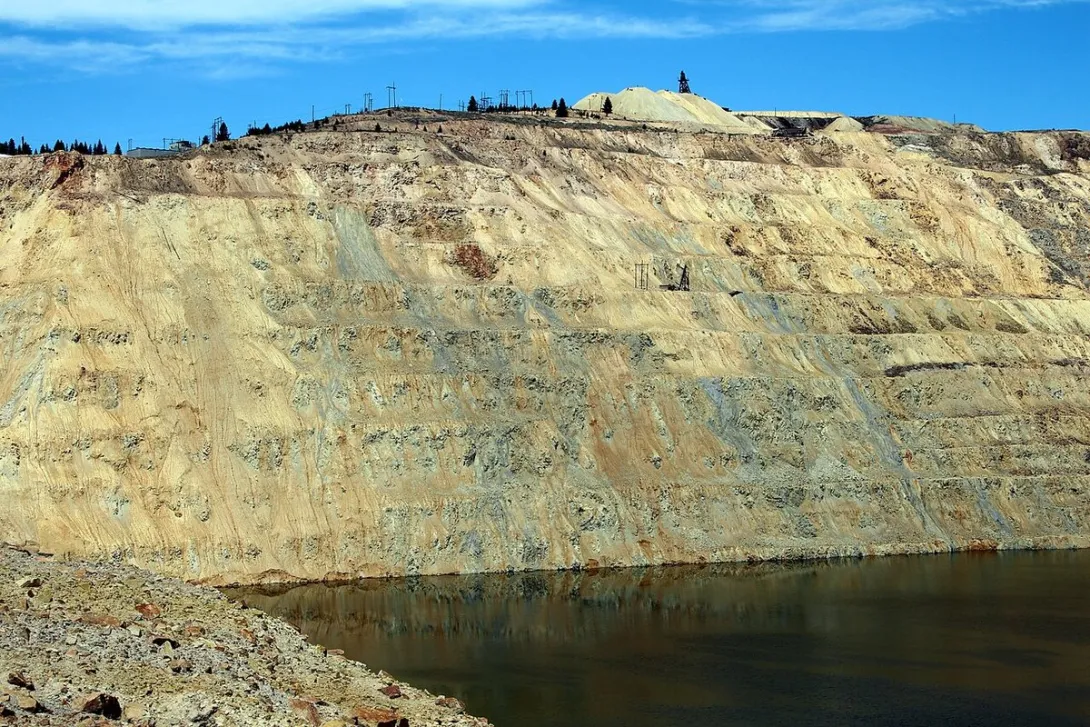
Today the Berkeley Pit is both a landmark and a warning. A public viewing stand on its rim lets visitors look across the terraced walls to the still, colored water far below, and Montana Resources continues to mine copper in the neighboring Continental Pit. The Berkeley Pit tells the full arc of Butte's copper story in a single view. It shows the scale of what open-pit mining could produce, it marks the ground where whole neighborhoods once stood, and it reminds visitors that caring for this place did not end when the mining stopped.
Photo: the Berkeley Pit in Butte. Photograph by Pahcal123, CC BY-SA 4.0, via Wikimedia Commons.