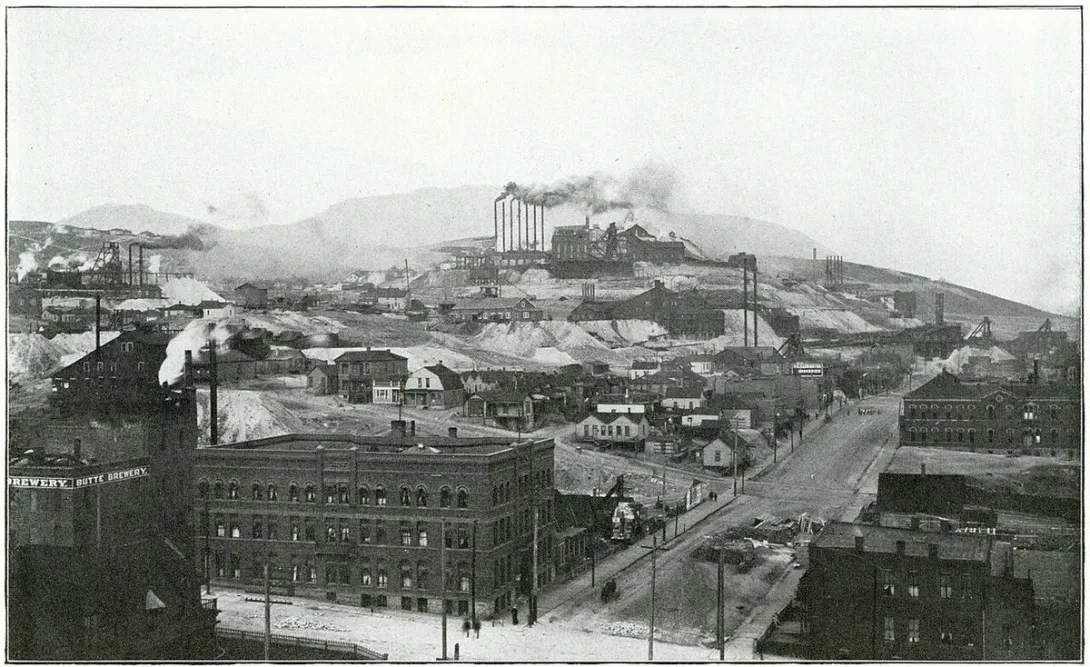
Did you know that when the Push Saloon opened in 1894, it was one of 165 saloons in Butte, and that a four-block walk up Main Street offered a choice of 35 similar establishments? That was wide-open Butte, the copper city where gambling was accepted and alcohol flowed at all hours of the day. In the photograph above, taken around 1900, the Butte Brewery anchors the lower left corner, a reminder that brewing and saloon keeping were pillars of the local economy. Temperance advocates pushed back for years. A 1907 Montana law banned women from saloons and forced owners to dismantle the partitioned winerooms where women had drunk, and in January 1910 the famous Carrie Nation marched up Arizona Street to Mercury Street, pleading with saloon keepers to close.
Click to see more photos of historic Butte
Montana went dry ahead of the nation. On November 7, 1916, voters approved state prohibition by 102,776 votes to 73,890, and the law took effect on December 31, 1918, more than a year before national Prohibition began on January 17, 1920. Butte, which had adamantly rejected prohibition, barely slowed down. Saloons like the Push sold soft drinks and cigars out front, enforcement often looked the other way, and the real trade moved underground, sometimes literally, into basements and rooms beneath the sidewalks. More than one hundred underground speakeasies operated in the city during Prohibition.
The most famous of them hid beneath the Rookwood Hotel, on North Main Street at East Broadway. James Pratt, proprietor of the Red Boot and Shoe Company, spent 30,000 dollars building the hotel in 1912, with his shoe store on the ground floor, green tile and a copper-clad cornice on the facade, and marble wainscoting inside. During Prohibition a hidden bar operated beneath the sidewalk there, complete with a secret entry and a two-way mirror, Tudor arches, carved griffin columns, and terrazzo floors. After Prohibition ended, the room was sealed and forgotten. Workers renovating the building in 2004 found a closet filled with untouched coats, and behind the coats a two-way mirror concealing the entrance to the speakeasy, frozen in time.
Bootlegging remade the liquor business, and women stepped into roles once reserved for men. In 1922 a federal prohibition officer whose car had broken down on Nettie Street went to a neighboring home for help and found Maud Vogen and her mother working a 20-gallon still. Across town, the old red-light district around Venus Alley had been driven underground in 1917, yet the Dumas Brothel at 45 East Mercury Street, founded in 1890 by brothers Joseph and Arthur Nadeau, kept operating through the entire era. It did not close until 1982, after the longest run of any brothel in the United States.
Montanans tired of the experiment sooner than anyone else. In 1926 the state's voters repealed Montana's own prohibition enforcement law, the first state repeal in the nation, although federal Prohibition lasted until December 1933. Butte's bars came back up to street level, and in 1934 the Silver Dollar Saloon opened in the old Push Saloon building, where it still links the city to its saloon heritage. Many speakeasies were simply sealed off, which is why the Rookwood could wait some seventy years behind a closet of coats for someone to find it again.