Did you know that in 1916, sixteen passenger trains a day stopped at one Butte depot? The Northern Pacific and Union Pacific station at 800 East Front Street was the busiest and longest-operated passenger depot in the city. Before there was a grand station, there was a modest wooden one. The Union Pacific, the first railroad to reach Montana, established a terminal a mile south of Uptown in 1881. When the Northern Pacific reached Butte in 1890, it shared that wooden depot, and as Butte grew into a metropolis, local businessmen lobbied for a grand union station.
Click to see more photos of the Butte, Anaconda and Pacific Railway
The Great Northern, which had arrived in the late 1880s, refused to join the plan, so in 1906 the Northern Pacific replaced the old depot with three hipped-roof buildings on Front Street. The center building held a general waiting room for three hundred people, separate men's smoking and ladies' private rooms, and the ticket and telegraph offices. Upstairs was a gallery promenade beside the railroad offices. The west building housed baggage and freight, and the east building held express offices and a restaurant. By 1916, twelve Northern Pacific and four Union Pacific trains stopped daily, plus specials such as the Union Pacific's summer Sunday fishing train. The last passenger train left the station in 1979.
Getting around inside Butte ran on rails, too. The street railway began in 1886, briefly with horses and then small steam engines, before electric streetcar service began in 1890 and ran for nearly half a century. Based at a carbarn and repair shop just east of Front Street, the system grew to thirty-five miles of track, reaching Walkerville in the north, Columbia Gardens in the east, and the Country Club to the south. Miners rode to their shifts and families rode to the Gardens until the last streetcars ran on September 22, 1937, after the Anaconda Company sold the system to National City Lines, which replaced them with buses.
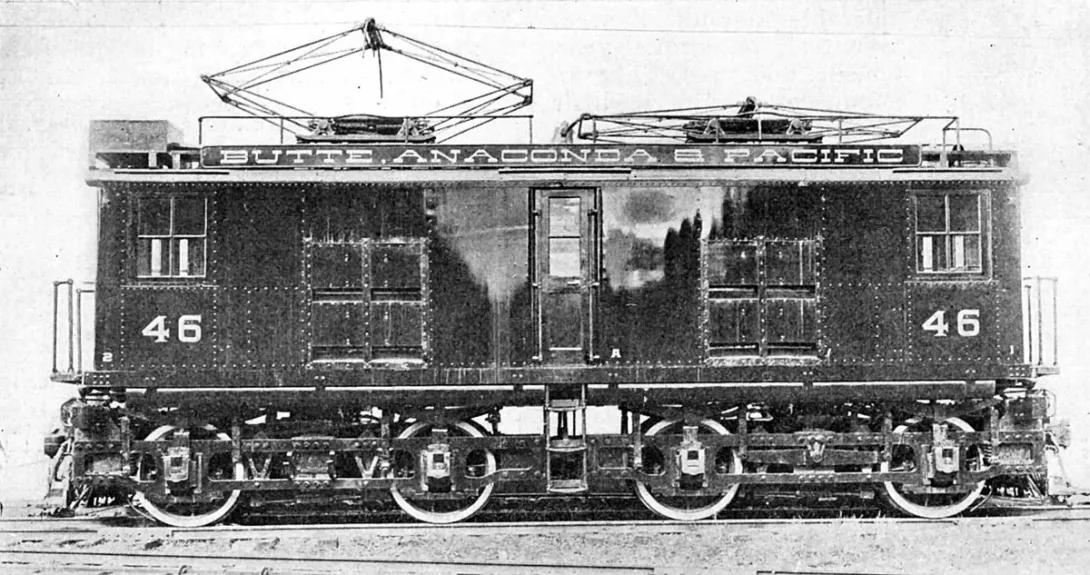
Butte's hardest-working railroad was the short line built for ore. The Anaconda Mining Company, with help from the Great Northern, built the Butte, Anaconda and Pacific Railway in 1893 to carry ore from Butte Hill to the smelter in Anaconda, after 1902 the Washoe Reduction Works. In 1913 General Electric designed its 2,400-volt direct-current electrification. Locomotives then took loaded hopper cars from each mine to the Butte Hill Yard, northeast of the Steward Mine, where crews made up thirty-car trains. Those trains rolled west 4.5 miles, downhill across Butte Hill and past the School of Mines, to the small railroad community of Rocker.
At Rocker, switch crews assembled the thirty-car cuts into sixty-car trains for the twenty-mile main line trip through Silver Bow Canyon to East Anaconda. There the long trains were broken into twenty-car trains for the steep, twisting seven-mile climb to the concentrator on smelter hill, and after the cars were emptied, the whole procedure reversed, back to the mines. The BA&P hauled far more than ore: it carried coal, coke, lumber, heavy mine timbers, and chemicals, brought general freight to Anaconda, and, into the early 1920s, ran four daily passenger trains each way carrying people, express, mail, and newspapers. For its first three decades it was also the primary way to reach Gregson Hot Springs, and by 1930 it owned all the tracks on Butte Hill. Electric operations ended in 1967, but the railway, known as the Rarus Railway from 1985 to 2007 and now owned by Patriot Rail, still carries copper concentrates out of Butte, a reminder that Butte once moved almost entirely on rails.