Few places on earth have earned a nickname as confidently as Butte. The mining district that residents called "the Richest Hill on Earth" was concentrated in only a few square miles of granite above the city, yet within that small area lay one of the greatest concentrations of valuable metal ever found. The hill produced copper above all, but it also yielded large quantities of silver, zinc, lead, manganese, and gold. The United States Geological Survey has calculated that Butte was the most valuable mining district in the United States, and historians of the district regard it as probably the most valuable small mining district anywhere in the world.
The hill's copper might have remained in the ground for generations if the wider world had not suddenly needed it. Western Union completed the first transcontinental telegraph line in 1861, but the decisive inventions came afterward. The telephone was invented in 1876, and Thomas Edison demonstrated practical electric lighting in 1879 and opened a commercial power station in New York in 1882. Every telephone line, dynamo, motor, and mile of electric wiring required copper, which conducts electricity better than any common metal except silver. Demand for copper rose sharply just as Butte's miners were proving that the hill held more of it than any district then known.
Production grew at a pace that matched the new electrical age. By the late 1880s Butte had passed Michigan to become the leading copper-producing district in the United States. By 1900, according to Encyclopaedia Britannica, Butte was yielding half of the nation's copper output. The National Park Service notes that the district was the source of nearly one third of the entire world's copper in the early 1900s, and from about 1905 to 1917 Butte produced between a quarter and a third of all the copper on earth. From the 1880s into the 1920s, Butte was the single largest copper producer in the world.
That copper went into the wires that carried electricity and telephone conversations across the United States and far beyond. It supplied the rapid electrification of American cities, the power systems and motors of new factories, and the communications networks that bound the country together. In both the First World War and the Second World War, Butte also produced copper and other metals that the United States and its allies needed. Historians of the district conclude, without exaggeration, that Butte's copper electrified the nation. In total, the district produced more than twenty billion pounds of copper between 1880 and 2004, along with hundreds of millions of ounces of silver.
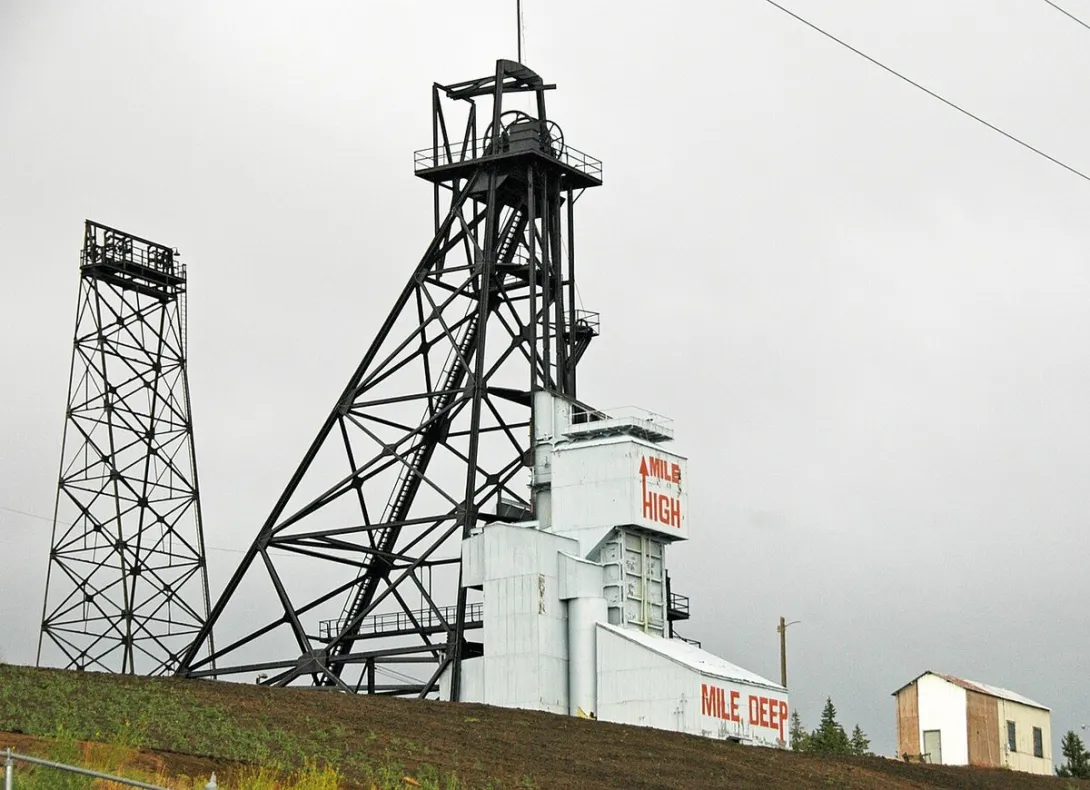
The wealth of the hill built a remarkable city. Immigrants arrived from Ireland, Cornwall, Finland, Italy, and many other lands, and by 1917 Butte and its neighboring camps held a population approaching one hundred thousand people, which made Butte one of the largest cities in the inland West. Miners worked beneath the city in an immense network of underground workings that eventually extended for thousands of miles, and the headframes of the great mines, including the Mountain Con, whose steel tower still carries the words "Mile High, Mile Deep," rose over the streets. Butte also became a national center of the labor movement, known in union circles as the "Gibraltar of Unionism."
The riches came at a heavy price in dangerous work, labor conflict, and lasting environmental damage. Open-pit mining at the Berkeley Pit began in 1955, and when mining ended in 1982 the pumps were shut off and the pit and the flooded underground workings became part of one of the nation's largest Superfund cleanup efforts. Today the Butte-Anaconda Historic District, designated a National Historic Landmark and expanded in 2006, preserves thousands of historic buildings, mine yards, and headframes. They stand as the physical record of a small Montana hill whose copper quite literally helped to wire the modern world.
Photo: the Mountain Con mine headframe in Butte. Photograph by James St. John, CC BY 2.0, via Wikimedia Commons.