Did you know that for most of a century, Butte was the most important and varied railroad center in the northern Rockies? The first railroad reached Butte in 1881, and thirty years later, in 1911, four transcontinental railways served the city. The Northern Pacific and the Milwaukee Road ran through main lines, while the Union Pacific and the Great Northern reached Butte at the ends of secondary lines, and the city was also the east end of a short line, the Butte, Anaconda and Pacific Railway. In 1916, railway work in Butte employed at least 850 people, including more than 200 on the street railway.
Click to see more photos of the Butte, Anaconda and Pacific Railway
Butte residents did not need a long-distance train to ride the rails, because the street railway carried them around town every day. The system began operation in 1886, briefly with horses and then with small steam engines pulling the cars, and a cable car also climbed Main Street toward Walkerville for nearly a decade before 1900. Electric streetcar service began in 1890 and then ran for nearly half a century. Based at the carbarn and repair shop just east of Front Street, the system grew to thirty-five miles of track that reached Walkerville in the north, Columbia Gardens in the east, and the Country Club to the south.
The busiest railroad of all was the one Marcus Daly built for himself. Tired of exorbitant freight rates and inconsistent service from the transcontinental lines, Daly established the Butte, Anaconda and Pacific Railway in 1892 to haul ore from the Butte mines to his smelter at Anaconda. He envisioned the line extending to the Pacific Ocean, but it ran twenty-six miles between Butte and Anaconda. The first trains ran from the Anaconda Company mines to the smelter on January 1, 1894, and by 1900 the BA&P was said to carry more tonnage to the mile, the year around, than any other railroad in the country, earning it the nickname the Biggest Little Railroad in the Nation.
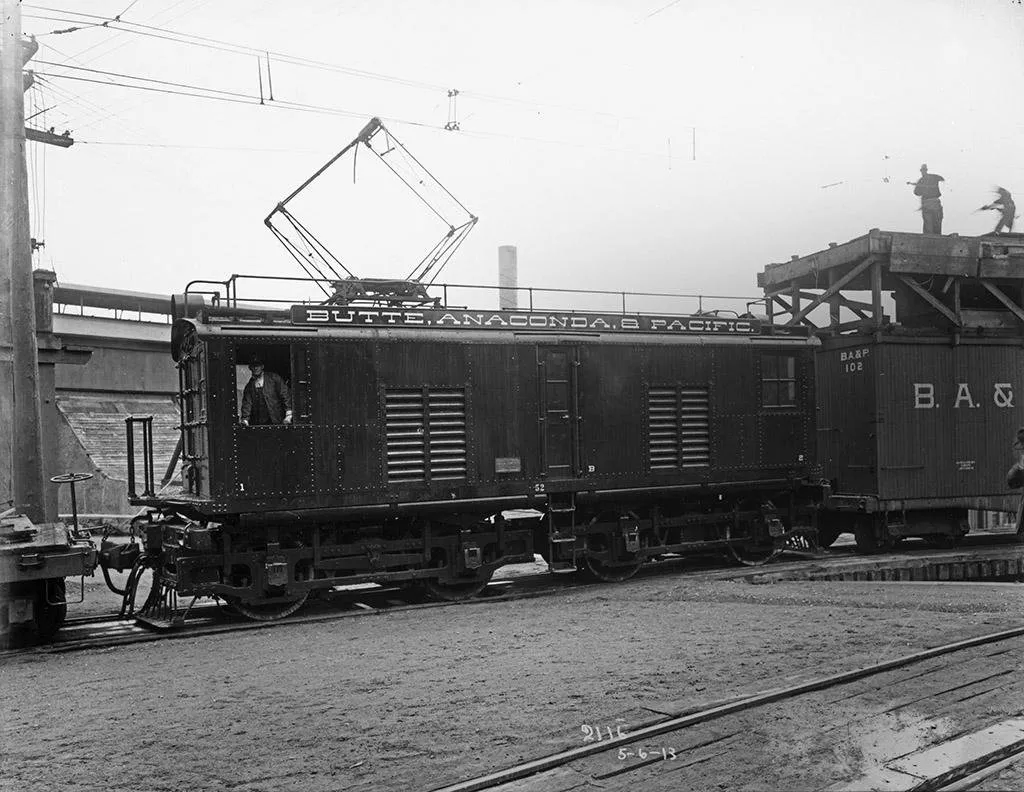
In 1913, the BA&P took a bold step that made railroad history. It converted its main line from steam to electric power, becoming the first heavy-haul electrified railroad in the world and the first electrified railroad in the country to haul heavy freight. Two advantages made it affordable: access to inexpensive hydroelectric power, and the fact that the Anaconda Company supplied the copper wire from its own mines, so the railroad that hauled Butte copper ran on Butte copper. Twenty-seven electric engines were built between 1913 and 1917, and they served until 1967. Only one survives today: No. 47, built in 1914, is part of the World Museum of Mining collection and is on display at the Anselmo Mine Yard in Uptown Butte, restored by retired railroad workers.
The age of the streetcar and the electric freight motor eventually gave way to buses and diesels. The Anaconda Company sold the street railway to National City Lines, and with the approval of the Montana Public Service Commission, the last streetcars ran on September 22, 1937, quickly replaced by motor buses, although many old tracks still lie beneath Uptown Butte's paved streets today. The BA&P ended passenger service in 1955 and replaced its electric locomotives with diesels in 1967, and in 1985 it was sold and reconstituted as the Rarus Railway, before its historic name was restored in 2007.
Photo: A Butte, Anaconda and Pacific Railway electric locomotive on May 6, 1913, photograph from the Anaconda Copper Mining Company, Montana Historical Society Research Center Photograph Archives, via Historic Montana. Public domain.