Marcus Daly was born on December 5, 1841, in Ballyjamesduff, County Cavan, Ireland, one of the children of a small farming family. He emigrated to the United States as a young man, worked his way west, and learned mining in Nevada, where he gained experience in the great silver mines of the Comstock Lode. There he also formed lasting business connections, including his friendship with the California mining investor George Hearst. Daly arrived in Butte in the summer of 1876 as an agent for the Walker Brothers, banking and mining entrepreneurs of Salt Lake City, and he purchased and managed the Alice silver mine in Walkerville for them, holding a small interest of his own.
While working underground in the Alice, Daly studied the neighboring mines and concluded that the hill held enormous deposits of copper ore. He urged the Walker Brothers to buy a small silver mine called the Anaconda, which had first been developed by Michael Hickey. When his employers declined, Daly sold his interest in the Alice in 1880 and bought the Anaconda himself. Because the mine would require far more capital than he possessed, he turned to his California friends for backing. George Hearst, James Ben Ali Haggin, and Lloyd Tevis agreed to support him, and together they organized the company that developed the Anaconda beginning in 1881.
The gamble succeeded beyond anything the partners could reasonably have expected. The Anaconda had been bought as a silver mine, and its upper levels did produce silver, but as the shaft went deeper the miners encountered a massive body of rich copper ore. By 1883 the workings had reached a copper vein of remarkable width and richness, among the finest copper sulfide deposits yet discovered. Daly quietly bought up neighboring claims while other owners, discouraged by the declining silver mines around them, were willing to sell. From 1892 through 1903, the Anaconda mine itself was the largest copper-producing mine in the world.
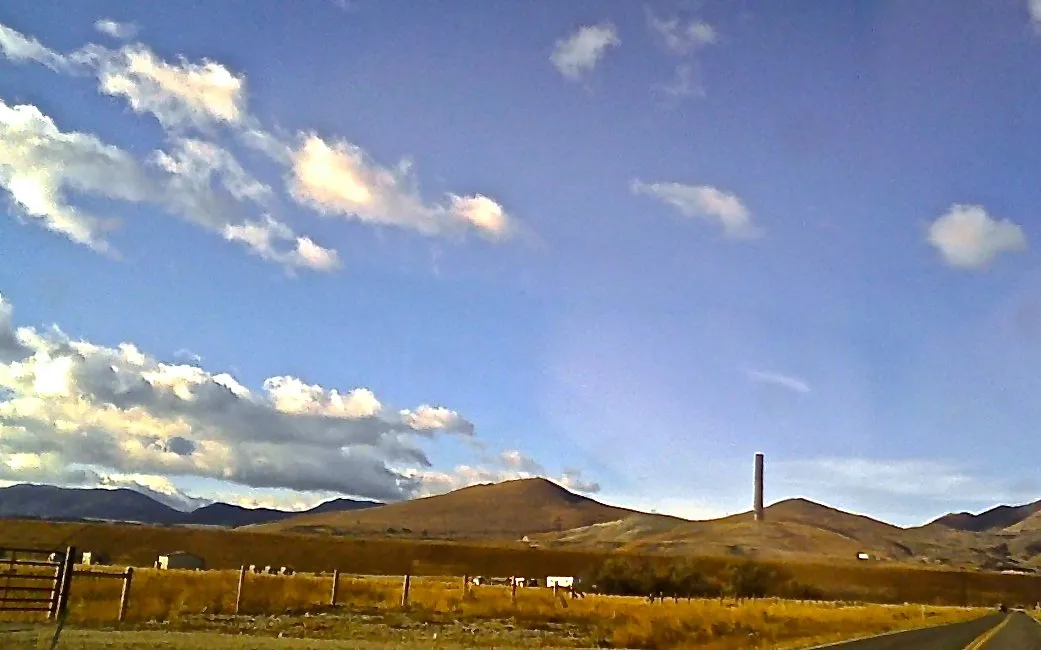
Copper ore was worthless without a means of treating it, so Daly built his enterprise on an industrial scale. In 1883 he founded the town of Anaconda, about twenty-six miles west of Butte on Warm Springs Creek, and built a large smelter and reduction works there to process the ore from his Butte mines. His company also acquired timberlands and coalfields to supply fuel and lumber, and the mines in Butte were later connected to the smelter by his Butte, Anaconda and Pacific Railway. The smelter stack that still stands at Anaconda, completed in 1919 for the company's Washoe Smelter, remains a monument to the scale of the works Daly set in motion.
Daly's rise made him one of the Copper Kings, and his long rivalry with William A. Clark became known as part of the War of the Copper Kings. The two men fought over mines, courts, newspapers, and Montana politics, and Daly worked for years to keep Clark out of the United States Senate. Their feud also divided Montana in 1894, when Daly campaigned to make Anaconda the state capital and Clark supported Helena, which won. A third rival, F. Augustus Heinze, later challenged the Daly interests in court and underground, but the Anaconda enterprise remained the dominant force in Butte.
In 1899 Daly joined with Standard Oil directors Henry H. Rogers and William Rockefeller to organize the Amalgamated Copper Company, into which the Anaconda properties were folded, and Daly served briefly as the new corporation's president. He died in New York City on November 12, 1900, at the age of fifty-eight. In 1915 the Amalgamated company took the name Anaconda Copper Mining Company, and for decades afterward the company that everyone in Montana simply called "the Company" dominated Butte's mines and much of the state's economy. The Atlantic Richfield Company purchased Anaconda in 1977, halted smelting at Anaconda in 1980, and ended mining at Butte in 1982. A bronze statue of Daly by the sculptor Augustus Saint-Gaudens now stands at the entrance to Montana Technological University in Butte, honoring the immigrant miner who built one of the largest mining companies in the world.
Photo: the Anaconda Smelter Stack, the surviving stack of the Washoe Smelter. Photograph by Montanabw, CC BY-SA 3.0, via Wikimedia Commons.