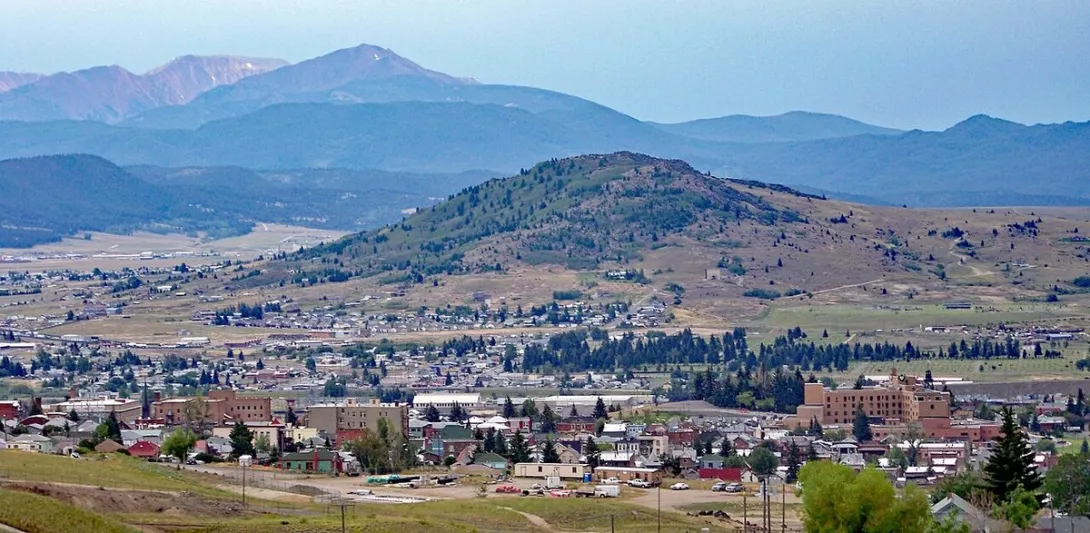
Butte began as a mining camp high in the Rocky Mountains of southwestern Montana, in the broad bowl of Summit Valley along Silver Bow Creek, near the Continental Divide. Montana became a separate territory of the United States in 1864, and in July of that year prospectors found placer gold in the gravels of Silver Bow Creek. News of the discovery drew miners to the valley, and the camp that grew up around the diggings took its name from Big Butte, the solitary conical peak that rises northwest of the settlement.
The first miners worked the creek gravels with pans, rockers, and sluice boxes, washing out flakes and nuggets of gold that had eroded from veins in the surrounding granite. The work was seasonal and uncertain, and water for washing gravel was often scarce in the high valley. Even so, the camp grew quickly for a time, and by 1867 several hundred people lived in and around the settlement. Cabins, stores, and saloons served the miners, and the camp followed the familiar pattern of the early Montana gold rushes that had already built towns at Bannack and Virginia City.
The placer gold, however, was limited, and within a few years the easily worked deposits were largely exhausted. Miners drifted away to newer discoveries, and by about 1870 the camp had shrunk dramatically and had nearly faded into obscurity. Many western camps in the same condition simply became ghost towns. Butte was saved by the men who stayed behind and looked more carefully at the dark quartz outcrops on the hill above the creek. Those outcrops held silver, and a few persistent miners believed that the real wealth of the district lay in its hard-rock veins rather than in its creek gravels.
The leading figure in that revival was William L. Farlin. Farlin had located claims in the district in the 1860s, and in 1874 he took up the Asteroid claim, the mine that was later renamed the Travona. In 1875 he found rich silver ore there, and he built the Dexter Mill, a ten-stamp mill, to treat the ore. Silver ore was first successfully treated at Butte in 1875, and Farlin's discovery demonstrated that the hill's veins could be mined and milled at a profit. The banker and merchant William A. Clark, who would later become one of the famous Copper Kings, provided financing in the district and acquired interests of his own.
A genuine silver rush followed in the middle and late 1870s. Prospectors crowded onto the hill, staking claims over the quartz lodes and sometimes disputing one another's ground, while investors such as Clark and Andrew J. Davis built mills to extract gold and silver from the ore. A townsite patent was issued in 1876, and by that year the prosperous camp numbered about one thousand residents. The neighboring camp of Walkerville grew up around the Alice Mine on the northern edge of the district, and in 1876 Marcus Daly arrived in Butte as an agent for the Walker Brothers of Salt Lake City to purchase and manage that silver mine.
In 1879 Butte was incorporated as a city, only fifteen years after the first prospectors had washed gold from Silver Bow Creek. The silver boom gave the young city banks, businesses, and a growing population, and economic expansion accelerated after the railroads reached Butte in the early 1880s. Few residents could yet have known that the copper in the hill's veins, largely ignored during the gold and silver years, would soon matter far more than either metal. The founding years had nevertheless fixed the pattern of Butte's life: a working mining town, built by prospectors and hard-rock miners, whose fortunes would always rise and fall with the wealth beneath the hill.
Photo: Butte, Montana, seen from near Big Butte. Photograph by James St. John, CC BY 2.0, via Wikimedia Commons.