Did you know that old Butte was not one town but many, stacked side by side on the Richest Hill on Earth? As copper drew workers from across the world, newcomers settled near people who spoke their language, cooked their food, and knew their saints and songs. By 1917 about 100,000 people lived in Butte, and imaginary lines divided the Hill into ethnic neighborhoods, each one a small homeland with its own churches, halls, bakeries, and boardinghouses.
Click to see more photos of Butte, Montana — its historic district, mines, and neighborhoods
The Irish, Butte's largest group, filled Dublin Gulch and Corktown. Italians built Meaderville on the east side, while Croatians, Slovenians, and other Eastern Europeans gathered in McQueen and East Butte. Finnish and Scandinavian families made Finntown, Cornish miners settled Centerville, Germans built Williamsburg, and Chinese merchants and workers sustained Chinatown. A short walk could carry you past a dozen languages, and every neighborhood worked the same mines, often side by side underground, then came home to very different kitchens.
Meaderville shows how lively those homelands could be. Named for Charles T. Meader, a miner who arrived in the late 1870s, it became Butte's Italian neighborhood, famous for gardens, home cooking, bakeries, and good meals. Because Meaderville sat in the county rather than the city, its saloons could keep the bar open and the tables set twenty-four hours a day, and men who worked hard underground played hard above ground. Adults spoke Italian at home, children grew up tending big gardens, and the whole community turned out for food and celebration.
Not every neighborhood was built by choice. The Cabbage Patch grew up on the eastern edge of the red light district, and for nearly twenty years, from 1880 to 1898, ownership of the land was tied up in a tangled legal battle. With no clear landlord, squatters built shacks there, and the Patch became home to many left behind by the boom, including widows, orphans, and miners who could no longer work. It lasted until 1940, when at least 225 buildings were demolished for a new low-income housing project built under the Federal Housing Act. Four shacks dating back to before 1890 have been preserved, small survivors of a hard and human place.
The saddest chapter came with open-pit mining. When the Anaconda Company broke ground for the Berkeley Pit in 1955, it bought and tore down thousands of houses and hundreds of stores, churches, and halls on the east side. East Butte, Meaderville, McQueen, Dublin Gulch, and Finn Town were uprooted, and some of their very ground was blasted and hauled away, so there is no street left to walk home on. Yet the names live on in family stories, parish histories, and reunions, and anyone who loves Butte still speaks of these neighborhoods in the present tense, as well they should.
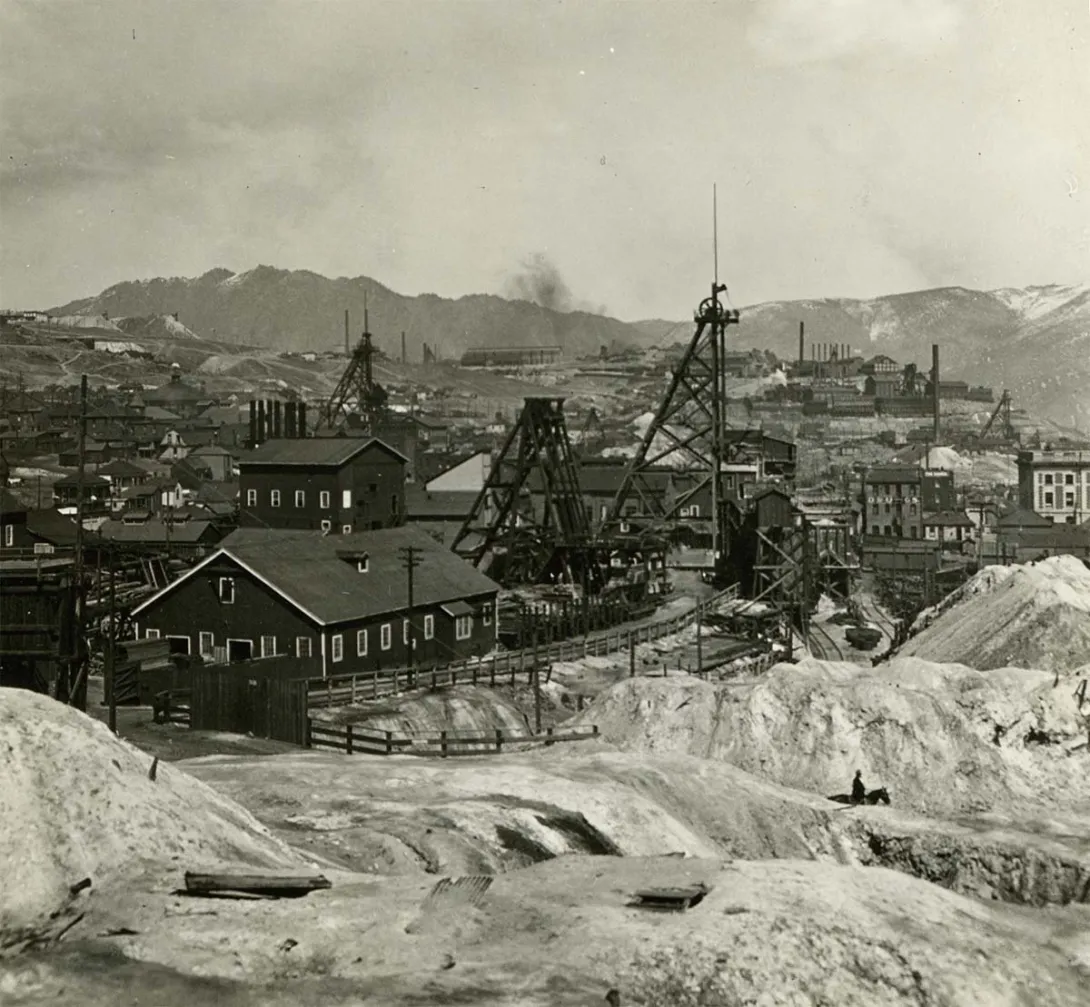
Photo: View of the mines at Butte, Montana, circa 1910, showing homes crowded among the headframes on the Hill. Public domain, via Western Mining History.